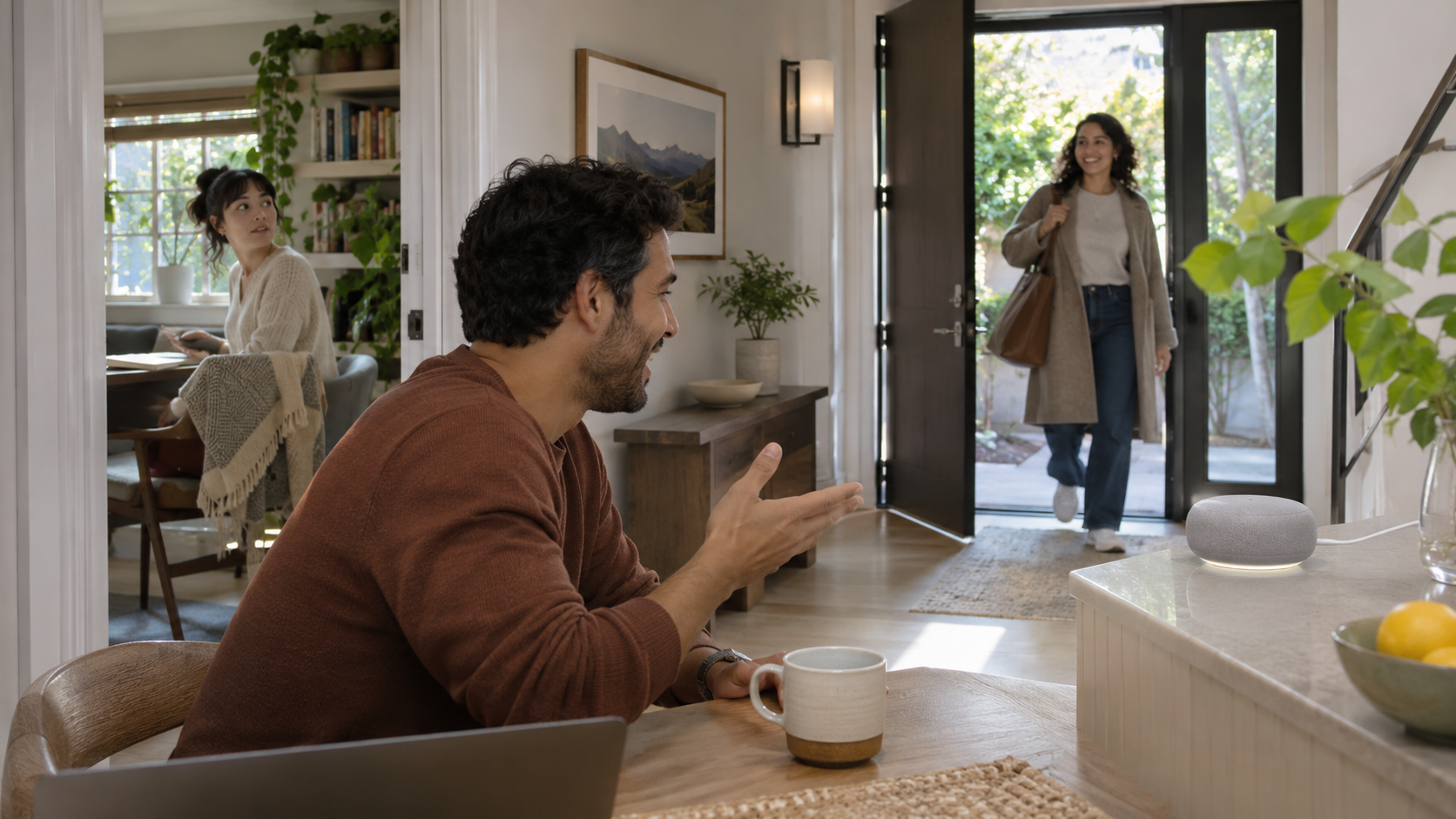
Google Home’s November 2026 update puts three household functions into one announcement: keyless entry, smarter audio alerts, and faster Gemini performance. The combination could affect access planning, sound-based notifications, and assistant responsiveness, but the available evidence supports only that these changes were announced. It does not establish compatibility, availability, or performance in any particular home.
What the evidence says
Google Nest Official Blog says the November 2026 Google Home update brings keyless entry, smarter audio alerts, and faster Gemini performance. That is the complete authoritative claim available here, and each element is concrete enough to define the update’s announced scope without supplying implementation details. Keyless entry concerns how a resident gains access without a conventional key. Smarter audio alerts describe an announced change to sound-related alerting. Faster Gemini performance describes improved speed for the platform’s assistant, although the source anchor supplies no benchmark, device list, or measurement method.
This is a primary-source announcement from the platform provider. No independent report is present to corroborate the availability, behavior, or performance of any of the three capabilities. Independent verification or testing is not available in this source set. Consequently, the evidence establishes what Google Home announced, not how consistently the update works, which households receive it, or whether its performance differs materially from the previous experience. It also does not support comparisons with competing systems, claims of superiority, or a recommendation to purchase compatible equipment.
Buyer and operator implications
Analysis: Buyers and installers should treat the update as a reason to investigate their specific deployment, not as proof that existing hardware will gain every announced capability. The three functions touch different operational concerns. Keyless entry can affect access control and recovery planning. Audio alerts may require testing against the sounds and acoustics of the intended home. Faster assistant performance needs a repeatable before-and-after comparison on the same equipment and network if speed matters to the decision.
Recommended verification before purchasing hardware, changing an installation plan, or relying on the update operationally:
- Verify which locks, hubs, speakers, accounts, and regions actually receive the November 2026 Google Home capabilities.
- Confirm how keyless entry is enrolled, shared, revoked, audited, and recovered if connectivity or credentials fail.
- Test whether audio alerts recognize the intended sounds in the real acoustic environment and whether notifications reach the appropriate people.
- Check what audio, event, household, or access data is collected, retained, shared, or available for review.
- Compare assistant response timing before and after the update on the same device and network, using consistent requests and conditions.
Installers should also document the pre-update configuration, update date, test conditions, and recovery path. Households should keep an existing access backup until the keyless workflow has been validated. These are conditional checks prompted by the announcement, not findings that the source itself reports.
Limits and verification
The source set does not establish supported device models, geographic rollout, account requirements, release sequencing, installation steps, subscription conditions, accessibility behavior, offline operation, or interoperability with other ecosystems. It provides no latency measurements for faster Gemini performance and no accuracy or false-alert results for smarter audio alerts. It also does not explain the security model, privacy controls, credential recovery process, or failure behavior for keyless entry.
Because the sole evidence is Google Nest Official Blog’s announcement, none of the capabilities has independent verification or testing here. Availability, reliability, privacy behavior, and practical value must therefore be checked in the target home before they influence a purchase, installation, or access-control decision.