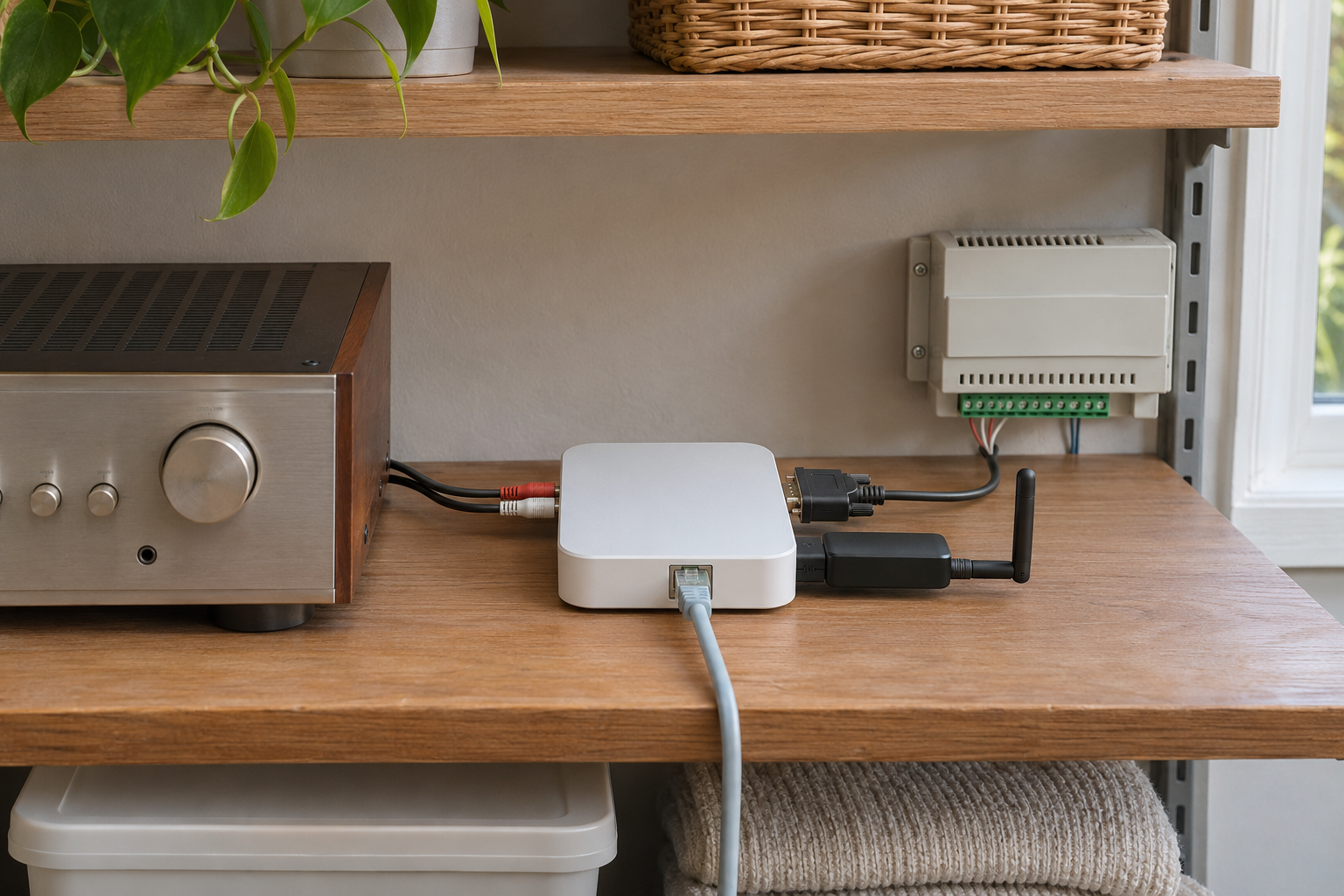
Home Assistant Connect AUX-2 is being positioned as a compact bridge between a modern automation setup and equipment that still works but lacks contemporary connectivity. Its announced functions span entertainment, serial-controlled infrastructure, wireless devices, and network-based placement. That breadth makes compatibility—not the length of the feature list—the central buyer and installer question.
What the evidence says
Home Assistant reports that Nabu Casa is launching Home Assistant Connect AUX-2 as a small, multipurpose adapter intended to bring older household devices into a smart-home environment. The primary-source announcement says the device can stream audio, control equipment through RS-232 serial connections, connect a Z-Wave adapter, and operate as a Bluetooth hub. For networking and power, it describes Power over Ethernet as an option while also stating that USB power and Wi-Fi can be used.
The announcement gives two concrete retrofit examples. Home Assistant says audio streaming can make an older hi-fi system play in synchronization with modern smart speakers. It also describes serial control as a way to incorporate functioning solar or climate equipment into automations, with lower energy consumption presented as a possible purpose for doing so. The source therefore frames the product around extending the useful role of existing equipment rather than requiring its replacement.
These details come from the product announcement itself. This source set contains no independent report that adds a separate perspective. Independent testing or verification is not available in this source set. Consequently, the evidence supports the stated functions and examples as announcement claims, but it does not establish real-world compatibility, performance, reliability, or energy savings.
Buyer and operator implications
Analysis: Home Assistant Connect AUX-2 could be relevant where several retrofit needs overlap—for example, an older audio system in one room and serial-controlled climate or solar equipment elsewhere. A single announced product covering those connection types may simplify the initial equipment shortlist. It should not, however, be treated as proof that every device using the same broad protocol will work, nor as a recommendation to buy.
Buyers and operators should map each intended use to a specific piece of equipment before deciding. The announcement identifies connection categories but does not provide the detailed compatibility boundaries needed for an installation decision. Recommended verification steps include:
- Verify that the exact hi-fi equipment and desired synchronized playback arrangement are supported, including the required physical audio connection.
- Confirm the RS-232 pinout, signaling requirements, command set, and control behavior of each solar or climate device with the relevant documentation.
- Check whether the intended Z-Wave adapter is compatible and whether its proposed location provides suitable coverage for the installation.
- Test whether Bluetooth range and placement are adequate for the devices the adapter is expected to serve.
- Compare PoE, USB power, Wi-Fi, and wired-network placement options against the power and network infrastructure available at the installation site.
Any energy benefit should also be evaluated as an automation outcome rather than assumed from connectivity alone. Serial access may enable control, but the announcement does not quantify savings or describe a universal energy-management method.
Limits and verification
This is a single-authoritative-source announcement briefing. The source set does not establish pricing, availability by region, shipping timing, dimensions beyond describing a small box, included accessories, detailed installation steps, protocol versions, supported adapter models, audio specifications, or compatibility lists. It also does not provide independently measured latency, synchronization accuracy, wireless range, uptime, security behavior, energy reduction, or comparative performance.
Independent testing or verification is not available in this source set. Installers should therefore treat every proposed connection as conditional until documentation for the final product and the target equipment can be compared, followed by a limited real-world test where practical. The announcement establishes the intended roles of Home Assistant Connect AUX-2, not the outcome of any particular deployment.