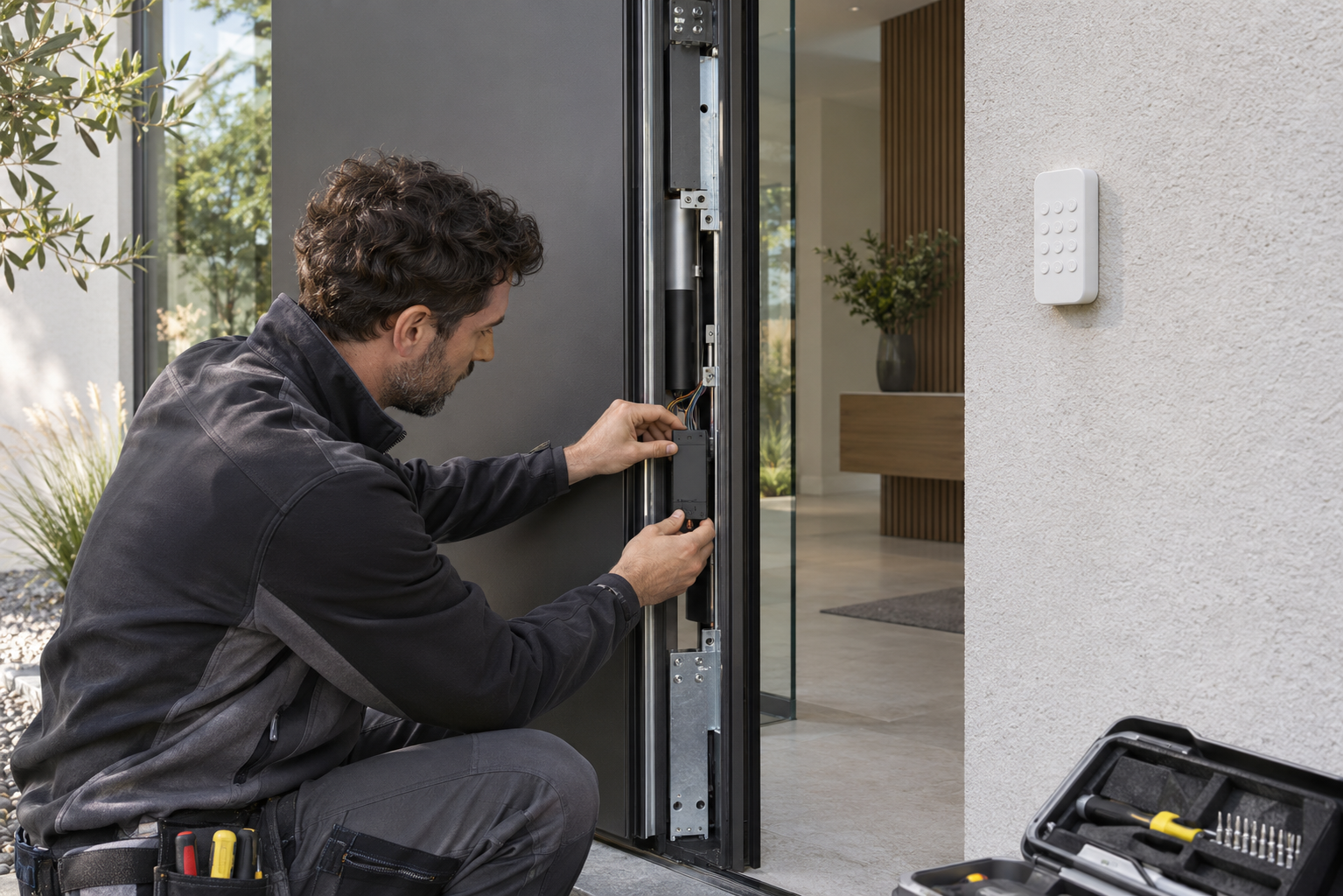
Nuki’s latest access products shift attention from a device mounted visibly on a door to technology integrated within the door itself. The Nuki Smart Module is now presented as a series-production option for modern motorized doors, including existing motorized locks through professional installers. Alongside it, the company has introduced the limited Keypad 2 NFC White with theft detection. The meaningful buyer question is therefore not simply whether to add smart access, but whether a concealed, installer-dependent approach fits the door project and its operational requirements.
What the evidence says
Nuki says the Smart Module has progressed from the prototype announced in March into series production on schedule. Its primary announcement describes the product as integrating technology from the company’s fifth smart-lock generation directly into modern doors, leaving no visible smart-access hardware. Nuki identifies two intended routes: factory-fitted integration in new construction and professional installation for existing motorized locks. That distinction is important because the evidence supports integration with motorized door hardware, not a universal retrofit for every conventional lock or door.
The same Nuki announcement documents an expansion of the keypad portfolio through a limited white edition of the Keypad 2 NFC. It specifically attributes theft detection to that edition, but the supplied evidence does not explain how detection works, what event triggers it, or what response follows.
HomeKit News independently reports that Nuki announced availability of the Smart Module and describes it as being designed to integrate smart-access functionality. This independent report supports the core launch-and-availability event. However, its supplied excerpt does not independently substantiate the primary source’s more detailed statements about series production, professional installation, compatibility with existing motorized locks, invisible placement, the keypad’s limited status, or theft-detection behavior. Those details remain claims from Nuki within this frozen source set.
Buyer and operator implications
Analysis: The Smart Module changes where project risk sits. A visible retrofit device can often be evaluated as a discrete product, while concealed integration makes the door, motorized lock, installer capability, and commissioning plan part of the purchase decision. For a new build, the appropriate time to resolve those dependencies is likely during door specification. For an existing motorized lock, the evidence explicitly points toward a professional installer, so buyers should not assume a straightforward self-installation path.
The Keypad 2 NFC White adds a separate choice. Its limited white finish may matter where external hardware must match an architectural scheme, while the claimed theft detection could affect placement and operating procedures. Because the evidence provides no implementation details, theft detection should be treated as a feature requiring demonstration rather than as proof that removal or tampering will be prevented.
Recommended verification before purchase:
- Verify that the exact motorized door and lock configuration is supported for Smart Module integration.
- Confirm whether installation must occur at the factory or whether a qualified professional can retrofit the existing motorized lock.
- Check what parts, door preparation, commissioning work, and installer responsibilities are required before approving the project.
- Test how the Keypad 2 NFC White reports or responds to a theft-detection event and who receives that signal.
- Compare the concealed installation with visible smart-lock hardware on service access, replacement effort, aesthetics, and installer dependence.
Operators should also document who will support the integrated system after handover. That is analysis rather than a sourced product promise: concealed hardware may be aesthetically cleaner, but buyers still need a practical route for inspection, fault diagnosis, and future replacement.
Limits and verification
The source set establishes an announced launch, reported availability, and Nuki’s stated positioning, but it does not provide pricing, market coverage, shipping timing by region, supported door or motorized-lock models, installation instructions, connectivity details, access-management behavior, power requirements, warranty terms, or installer availability. It also does not establish how theft detection functions or whether the white keypad remains available for any particular period. HomeKit News corroborates only the broad availability announcement and integration purpose in the supplied excerpt. Buyers should therefore treat detailed compatibility, security behavior, serviceability, and project cost as unresolved until verified through product documentation and a qualified installer.