Onvis's $44.99 T20 Needs an Electrician-and-Energy-Data Check
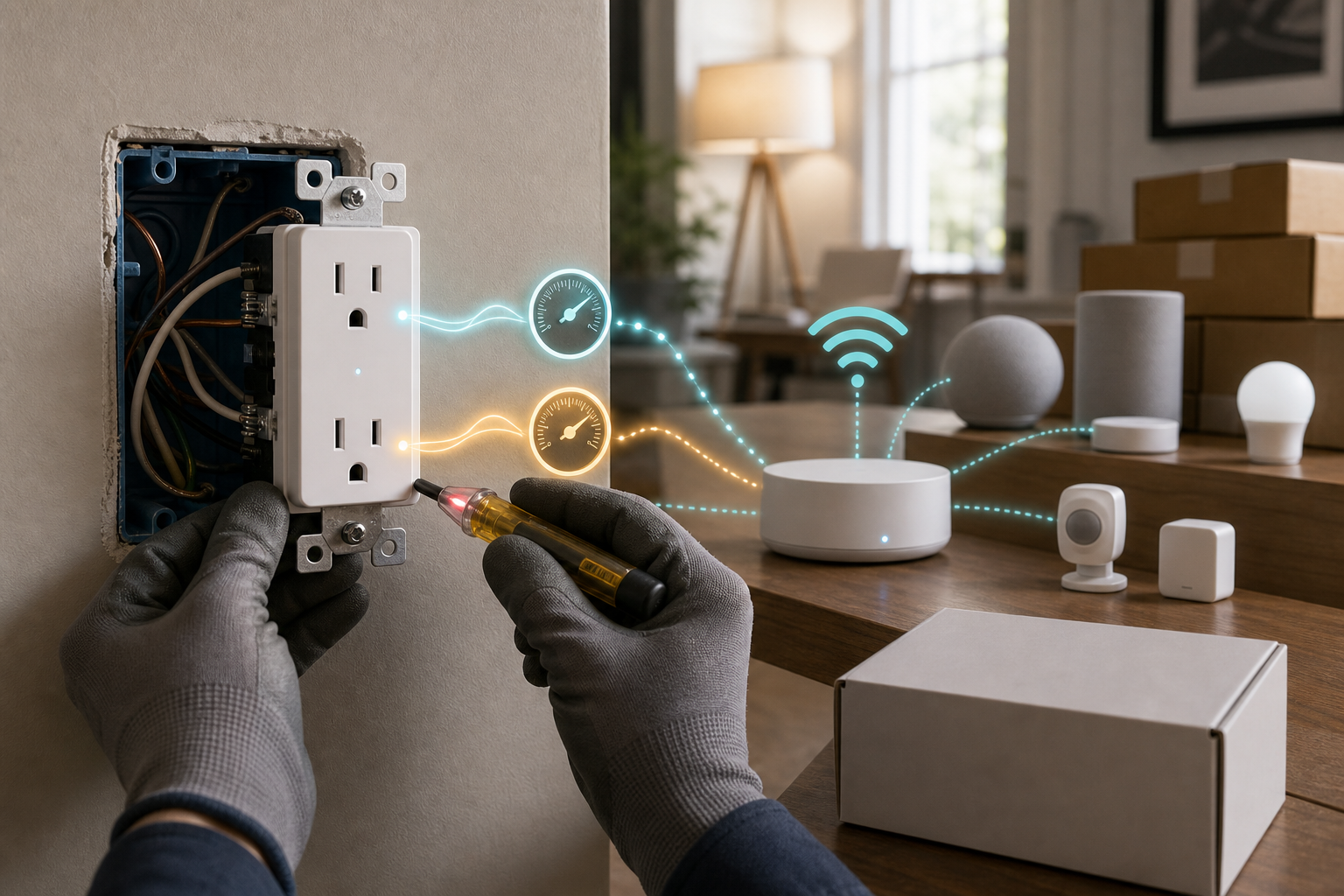
Onvis's T20 puts two independently controlled Matter-over-Thread outlets and per-outlet energy monitoring into one wall receptacle. At a listed $44.99, that sounds cleaner than stacking plug-in adapters—and more permanent.
Permanent is the important word. This is not a smart plug you can move after a weak-signal test or return without touching household wiring. The buying decision has three gates: electrical fit, Thread fit, and proof that your preferred ecosystem exposes the controls and energy data you expect.
The T20 can be a tidy upgrade. It should not be an impulse purchase.
What the $44.99 Actually Buys
Onvis lists the North American T20 as a dual 120V indoor wall outlet rated up to 15A/1800W. The company says each receptacle can be controlled independently and its power consumption tracked separately. The page names Apple Home, Alexa, Google Home, and SmartThings, and requires both a Matter-over-Thread border router and an ecosystem app and account.
The Connectivity Standards Alliance record adds useful precision. It identifies the T20 as a Matter 1.4 end product using Thread, with Matter power meters and firmware version 1.2.5. It also describes the outlet as a Full Thread Device that can help extend a Thread network.
Independent reporting from Matter Alpha confirms that power monitoring is the main addition across Onvis's updated U.S., EU, and UK outlet family. But none of the checked evidence provides a platform-by-platform feature table.
That omission matters. Matter certification confirms a compliant product and data model; it does not guarantee that every controller presents live watts, accumulated energy, timers, holiday mode, logs, or two-outlet automations in the same way.
Price the Installation, Not Just the Outlet
A $44.99 device can become a materially larger project once labor and location constraints enter the picture. The Electrical Safety Foundation International recommends that qualified, licensed electricians perform home electrical work. For this outlet, the real pre-purchase checklist includes the box, circuit, grounding, connected load, local code, and any required GFCI, AFCI, or tamper-resistant protection.
Do not assume that a location suitable for an ordinary receptacle is automatically suitable for this model. Onvis labels the T20 for indoor use from 32F to 104F. Its 15A/1800W figure is a maximum rating, not permission to ignore the combined loads on both receptacles or the circuit serving them.
Ask for the installed cost before deciding that a wall outlet is cheaper than two removable smart plugs. The permanent option earns its premium through appearance, independent dual control, and useful metering—not merely by hiding the hardware.
Run a Two-Outlet Acceptance Test
Install one T20 before committing to a room or whole-home rollout. Then test it in the ecosystem you actually use:
- switch the upper and lower receptacles independently; - confirm that automations address the intended outlet every time; - compare live power and accumulated energy fields for each receptacle; - verify which timers, logs, and vendor features remain outside the ecosystem; - interrupt the controller, Thread border router, and branch power separately, then check recovery; - inspect Thread placement before assuming the outlet improves coverage for nearby devices.
A mains-powered Full Thread Device may strengthen a mesh, but certification is not a promise about routing behavior in a particular floor plan. Walls, distance, neighboring routers, border-router placement, and network policy still shape the result.
Read the Privacy Claim Narrowly
Onvis says the T20 requires no cloud, registration, or data tracking. The same listing also requires an ecosystem app and account. Those statements can coexist: the outlet may avoid an Onvis cloud while Apple, Amazon, Google, or Samsung still supplies the control account and remote-access layer.
Review the destination ecosystem's telemetry and remote-control settings, and keep physical and breaker access available. A wall outlet should remain understandable and serviceable even when its smart layer is unavailable.
The T20 is most compelling for a visible location where two independently controlled loads, clean installation, and real energy data all matter. Verify stock first—the listing was sold out when checked—then price the electrical work and prove the full two-outlet feature set before installing more.
- https://onvishome.com/products/onvis-smart-wall-outlet-t20-matter-over-thread-15a-1800w-max-works-with-apple-home-alexa-google-home-smartthings - https://csa-iot.org/csa_product/onvis-outlet-t20/ - https://www.matteralpha.com/industry-news/matter-open-day-2026-ecosystem-maturation - https://www.esfi.org/home-safety