FireAvert's Home Assistant Badge Does Not Make a Stove Shutoff a Smart Plug
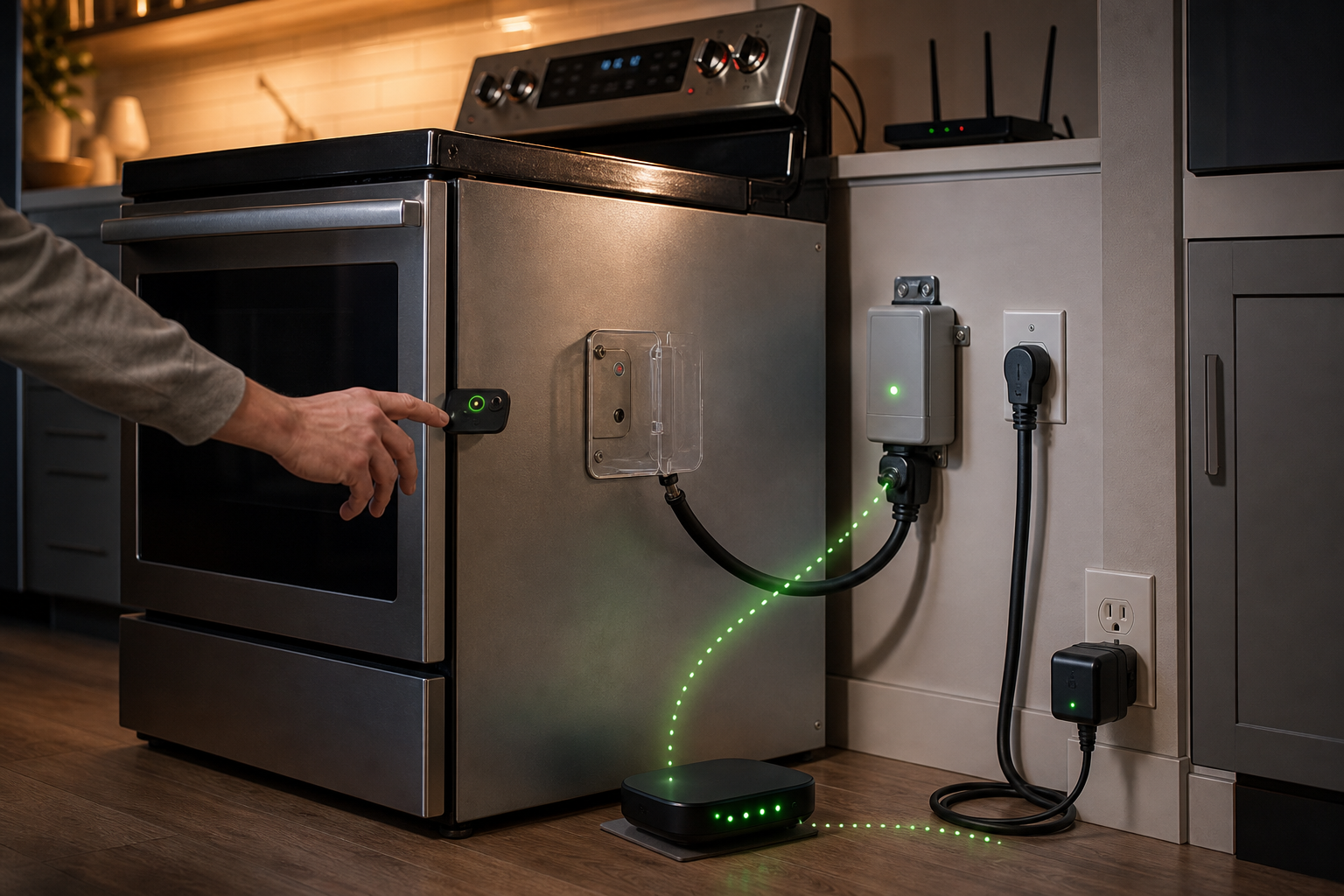
FireAvert's first four Works with Home Assistant devices solve a serious smart-home problem: they can cut energy to a stove or high-risk appliance, report through Z-Wave, and keep their core protection working when the network is down.
That last point is the reason to pay attention. This is safety hardware with a smart interface—not a smart plug that happens to carry a large load.
What the Badge Actually Covers
Home Assistant certified FireAvert's 240-volt three-prong and four-prong electric stove shutoffs, 120-volt appliance shutoff, and gas shutoff. Its test setup used Home Assistant Green, Home Assistant Connect ZWA-2, and the Z-Wave integration.
The program says certified devices must provide expected Home Assistant functionality, work locally without a required cloud, and carry a long-term support commitment. Home Assistant also says FireAvert's protective function does not depend on Z-Wave or a battery: the inline device remains on duty while the appliance has power.
That is a useful certification boundary. It does not verify every Z-Wave adapter, smoke-alarm placement, range outlet, gas connection, or custom automation.
The Safety Logic Stays in Charge
FireAvert's Z-Wave 800 integrator guide makes the control model unusually clear. A controller may request shutoff at any time. Turning the appliance back on is different: a re-arm request can be rejected when the device's safety conditions are not satisfied.
For gas models, physical interaction is required before the device becomes re-armable. The guide says Z-Wave cannot remotely re-arm the gas valve without that step. That limitation is a feature; someone should verify the scene before fuel flow returns.
Electric models have another important distinction. Their automatic re-arm path waits and checks current, shutting back down if a heating element was left on. But the guide says an explicit Z-Wave re-arm request always re-arms the electric device regardless of heating-element state.
Do not put electric re-arm in a broad “arrive home,” “alarm cleared,” or presence-only routine. Confirm every control is off first, then make restoration a deliberate action available only to trusted users.
Four Models Mean Four Fit Checks
FireAvert's U.S. product page listed the Z-Wave shutoff at $249.99 when checked on August 3, with gas, 240V four-prong, 240V three-prong, and 120V small-appliance choices. Match the exact appliance and connection before ordering.
For an electric range, the company's instructions start with turning off the breaker, pulling the stove forward, connecting the range cord to the shutoff, and plugging the shutoff into the wall. Independent CES reporting notes that the enclosure is larger than a standard plug, so check the appliance's rear or lower clearance too.
Gas is not the same project. It adds a shutoff solenoid, gas-line work, and a leak-safety check. Follow the current manual, local requirements, and qualified-installation rules rather than generalizing from the electric plug-in steps.
The network has its own gate. The integrator guide requires an S2-enabled controller because the device requests S2 Access Control security. It supports SmartStart and classic inclusion; Z-Wave Long Range requires SmartStart. The Home Assistant badge proves the Green-plus-ZWA-2 test path, while other controllers and adapters still need installation-specific validation.
Test the Failure Paths, Not Just the Dashboard
Before relying on the system:
- Verify the model, voltage, plug, breaker, physical clearance, smoke alarm, and controller security support. - Include it securely, then confirm status, shutoff, safety-lockout, and re-arm behavior. - Test with the actual household smoke alarm according to the current product instructions. - Confirm the autonomous shutoff still works with Home Assistant and the Z-Wave network unavailable. - Restrict re-arm permissions and document the different gas and electric recovery steps.
Because the device listens for an existing smoke alarm, alarm maintenance and placement remain part of the protection path. A connected shutoff supplements working alarms, safe cooking practice, and emergency response; it does not replace them.
The Decision
The Works with Home Assistant badge is valuable because it pairs local observability with protection that does not disappear during a hub or network failure. Buy the certified Z-Wave model when that local status and deliberate remote shutoff are worth the added setup.
Just keep the hierarchy straight: the safety device owns the hazard response. Home Assistant observes it, reports it, and can request actions. Any automation that restores heat or gas deserves stricter review than the automation that turns on a lamp.
- https://www.home-assistant.io/blog/2026/07/28/fireavert-joins-works-with-home-assistant/ - https://products.z-wavealliance.org/wp-content/uploads/products/80672/fireavert_integrators_guide_rev_a12.pdf - https://fireavert.com/pages/z-wave-product - https://www.securityinfowatch.com/ces-show/article/55344711/automatic-stove-shutoff-device-for-fire-safety