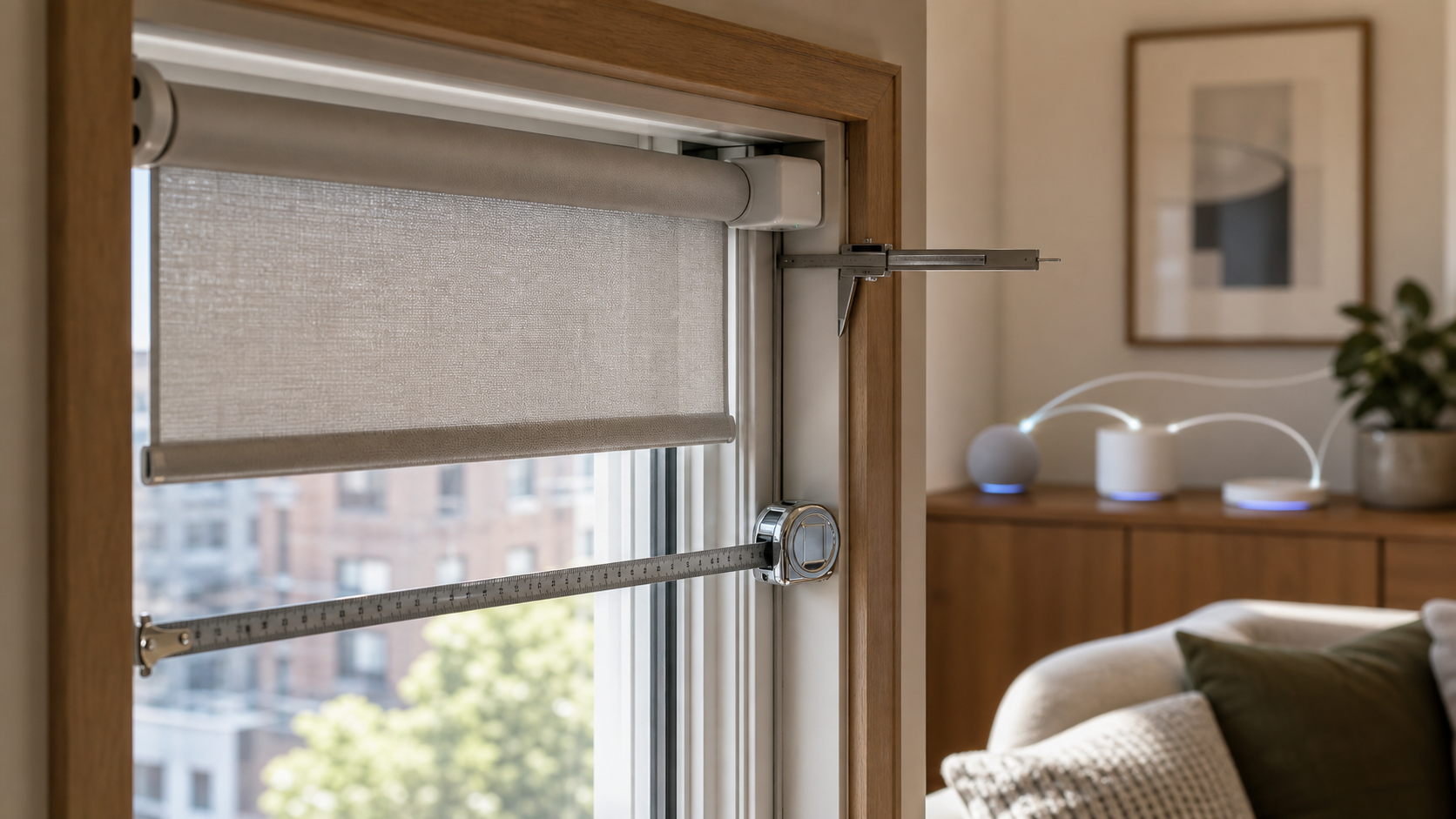
No-Drill Smart Blinds Are Still A Measure-First Buy
The strongest feature of Kincmo's no-drill motorized shades is not Matter. It is the tension mount that can put a custom shade inside a window frame without screw holes.
That makes the product interesting for renters and anyone who wants a reversible installation. It does not make the order forgiving. A custom shade can be tool-free to mount and still be expensive to get wrong.
Before choosing fabric or connecting a smart-home platform, buyers need to pass two checks: will the shade fit the window, and will the selected motor fit the home's control system?
No Drill Does Not Mean No Measuring
Kincmo's current Classic no-drill listing covers widths from 22 to 115 inches and heights from 15 to 130 inches. For an inside mount, the company tells buyers to submit the exact opening size, then says it deducts one eighth of an inch from the finished shade.
Frame depth is just as important. Kincmo lists a 1.4-inch minimum for its fabric-insert/no-drill valance and 1.6 inches for the square valance.
Those numbers turn the buying process into a fit test. Measure the opening's width at the top, middle, and bottom. Check the available depth at the shallowest point. Account for handles, locks, trim, and any window that tilts inward. If the opening is not square, ask the manufacturer which measurement governs before placing a custom order.
WIRED's smart-shade guide gives the same practical warning: measure repeatedly and have another person compare the result. Made-to-order shades can look excellent, but an inside mount that is slightly too wide may not install, while one that is too narrow can leave unwanted light gaps.
The Motor Choice Changes The System
Kincmo's order page separates three control paths: a direct Matter-over-Thread motor, a motor that works through a separate Matter hub, and a standard motor controlled by a remote.
These are not interchangeable labels.
The direct Matter-over-Thread option requires a compatible Thread Border Router and a Matter Controller. Kincmo gives a HomePod mini as one Apple Home example because it can perform both jobs. A buyer using Google Home, Alexa, or SmartThings needs to verify that the exact controller model in the home supports both the required Matter role and current Thread setup.
Multi-platform control adds another step. Kincmo says each ecosystem needs its own Matter Controller. The shade can be commissioned in one platform and shared to another through Matter multi-admin, but the second platform still needs its own controller.
The useful rule is simple: native Matter can remove a proprietary shade hub from the shopping list, but it does not remove infrastructure.
What Independent Testing Adds
WIRED tested a long Kincmo blackout shade and reported that it worked very well. The reviewer found it slow to open and close, but quiet at under 40 decibels.
That is encouraging for a bedroom or shared workspace, where motor noise matters. It is not a performance promise for every width, fabric, or mount. Larger shades carry more material, and a tension-mounted custom order should be checked for the maker's applicable weight limits.
Price also needs a configured-cart check. WIRED notes that smart-shade starting prices can rise substantially as size and options are added. Compare the final price with the correct motor, valance, fabric, remote, charger, and any controller the home still needs.
Privacy And Reliability Checks
Kincmo says its Matter-over-Thread shades can operate locally without a cloud dependency. That is useful for basic positioning and automations, but adding multiple ecosystems expands the number of household permissions and remote-access settings to review.
Store the Matter setup information securely, keep controller and shade firmware current, and test automations after any platform update. Keep the shade path clear, and recheck the tension mount after installation—especially on a large or frequently used window.
The Takeaway
Kincmo's no-drill design can remove the messiest part of a smart-shade installation. It cannot remove the consequential decisions.
Measure the frame, verify the valance depth, check obstructions, select the exact motor, and inventory the home's Thread and Matter controllers before ordering. If those pieces line up, no-drill Matter shades can be a clean renter-friendly upgrade. If they do not, the easiest installation is the one that never fits.
- https://homekitnews.com/2026/07/16/kincmo-no-drill-smart-blinds-w-matter-over-thread-video/ - https://www.kincmo.com/collections/new-arrivals/products/kincmo-no-drill-roller-shades-motorized-100-blackout-classic - https://www.kincmo.com/pages/matter-over-thread - https://www.wired.com/gallery/best-smart-shades-blinds-curtains/