IoTorero's Garage Door Opener Is A Safety-System Check First
IoTorero's garage-door controller now carries the Works with Home Assistant badge. That is useful evidence for local integration. It is not evidence that every garage door, motor, wall control, sensor, and remote-close automation will form a safe system.
The right buying question is not simply, “Will Home Assistant discover it?” It is, “Can this accessory trigger my exact operator, report the door's real position, and preserve every required safety behavior?”
The Signal
Home Assistant added IoTorero's Garage Door Opener to a seven-device certified lineup on July 9. The announcement says these ESPHome devices operate locally and were checked for local control, privacy, long-term support, and expected Home Assistant functionality. Testing used Home Assistant Green and the ESPHome integration.
That makes the product interesting for anyone who wants garage control without depending on a manufacturer cloud. The current product page lists an ESP32-C3, pre-flashed ESPHome, 2.4GHz Wi-Fi, 5V/1A power, and a US$18.75 sale price when checked July 14.
The badge answers the platform question. The installation still decides whether the product is a fit.
What The Controller Actually Does
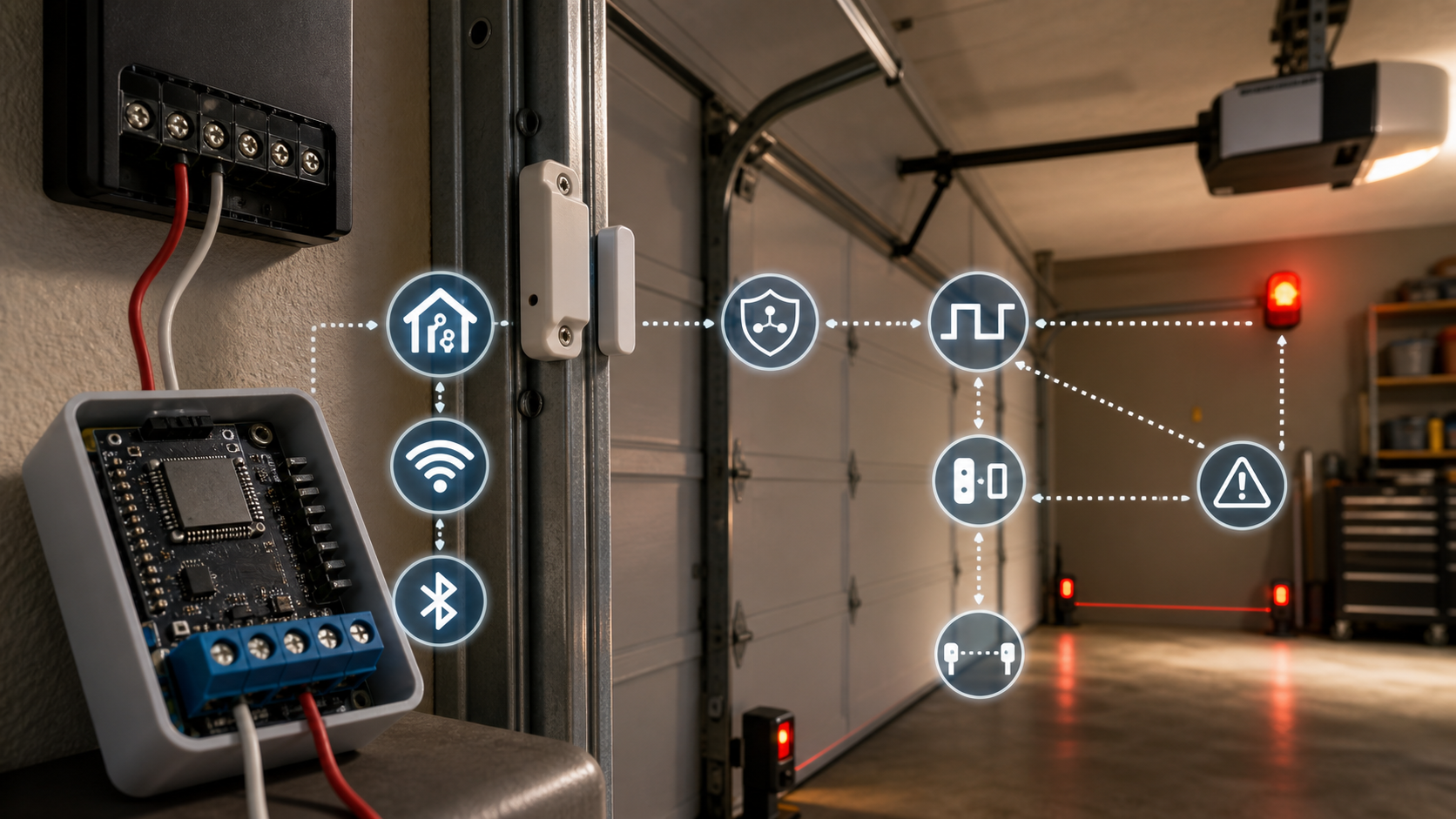
IoTorero describes a simple compatibility test: if momentarily connecting the two garage-door control terminals makes the door move, its relay can imitate that button press. The current ESPHome configuration supports that model. It turns the relay off after one second, while a separate contact input reports whether the door is open or closed.
Those are two different jobs. A successful command proves that the relay reached the operator. It does not prove that the door moved, finished moving, reversed around an obstruction, or now has the state shown in Home Assistant.
An independent review of an older Athom version found the same basic pattern: a relay for the button action and a magnetic reed switch for position. The current product uses newer hardware, so that teardown should not be treated as a current specification. It still illustrates the installation logic: trigger and state must both work.
Buyer / Operator Lens
Start with the opener manual, not the accessory price. Some operators accept a simple momentary input. Others use a proprietary or digital wall-control bus. IoTorero's terminal test can identify a simple trigger path, but it should be performed only as the opener manufacturer directs or by a qualified installer. A working trigger is not a complete compatibility verdict.
Next, plan the position sensor. Mounting has to keep the magnet and contact aligned in the fully closed position without interfering with the moving door. Test the displayed state after a wall-button cycle, a remote cycle, a manual release, a power interruption, and a controller restart. The firmware allows the contact logic to be inverted, which is another reason to verify “open” and “closed” physically.
Finally, treat remote closing as a safety feature, not a convenience toggle. In the United States, 16 CFR 1211.14 requires specified entrapment protection for unattended closing, prohibits that feature on one-piece and swinging doors, and requires audible and visual warning for at least five seconds before movement. A separate accessory must not override the operator's protection features. Other jurisdictions and the opener manual may add different requirements.
What To Check Before Acting
- Confirm the exact opener model, door type, control-terminal behavior, and accessory markings. - Verify the photo eyes, reversal behavior, manual release, and every protection required by the operator manual. - Test the contact sensor independently from the relay; never infer door position from a command alone. - Confirm reliable 2.4GHz Wi-Fi in the garage and keep physical controls usable during a network or controller outage. - Restrict remote operation, protect the Home Assistant account, and avoid automatic closing until the complete system is verified for unattended use.
The Takeaway
IoTorero's certification is a positive signal for local Home Assistant buyers. It says the ESPHome integration path has been tested and the product is intended for long-term local operation.
Buy it only after the mechanical and safety questions pass too. The best garage-door controller is not the one that can send a command from anywhere. It is the one that fits the exact operator, reports real state, fails predictably, and leaves every safety layer intact.
- https://www.home-assistant.io/blog/2026/07/09/iotorero-joins-works-with-home-assistant/ - https://www.athom.tech/blank-1/garage-door-opener-for-esphome - https://www.law.cornell.edu/cfr/text/16/1211.14 - https://www.espthings.io/index.php/2021/10/28/athom-smart-garage-door-opener-for-esphome/ - https://raw.githubusercontent.com/athom-tech/esp32-configs/main/athom-garage-door.yaml