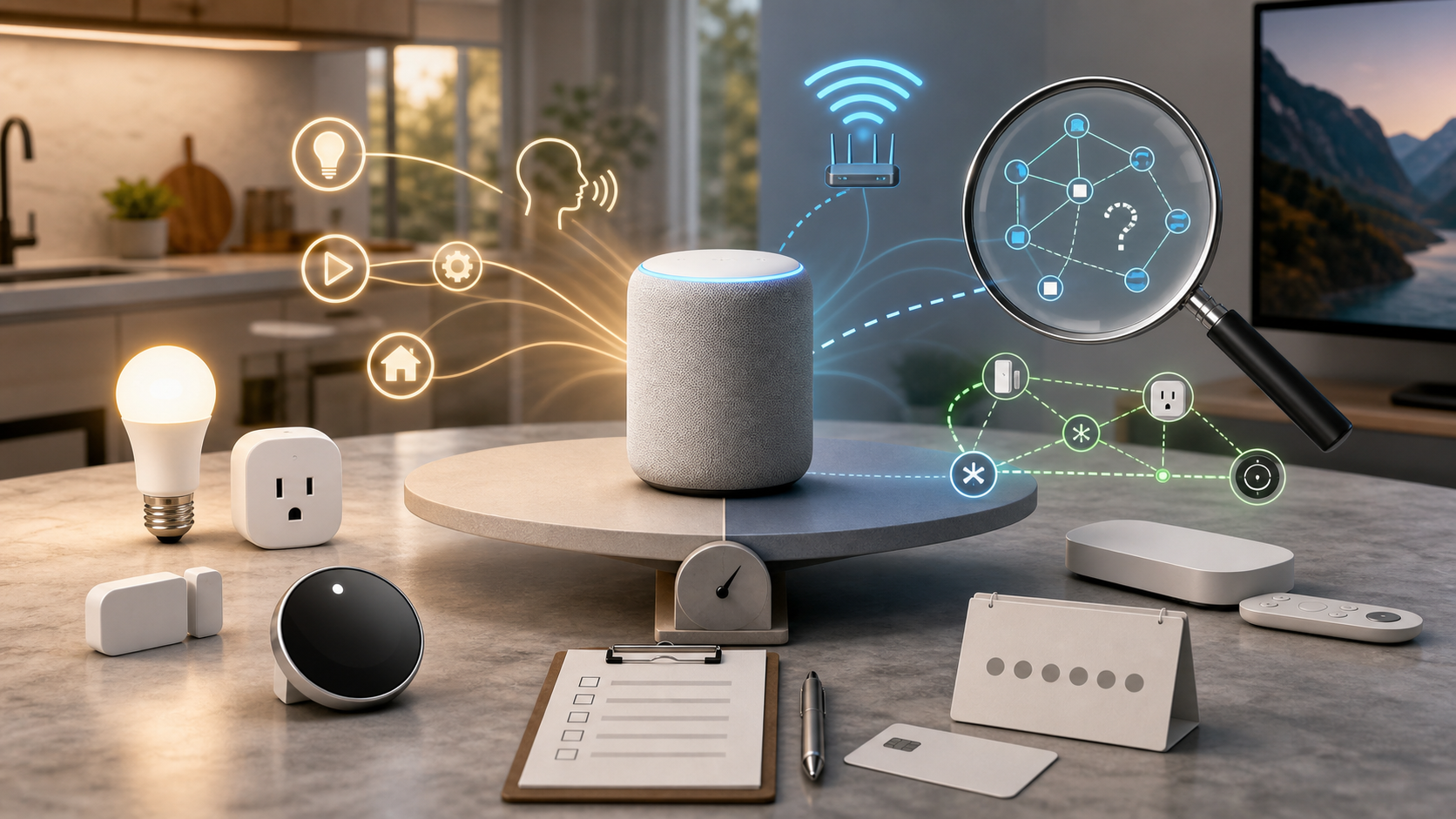
Google Home Speaker Is a Hub Check, Not Just a Gemini Upgrade
Google's new Home Speaker is finally a real purchase decision. Google says the Gemini-built speaker is available for preorder at $99.99 and reaches shelves on June 25, 2026. That makes the easy question, "Is the new assistant better?" The better smart-home question is: does this speaker actually improve the room, the hub plan, and the subscription math?
For many homes, the answer may be yes. A compact voice speaker that also fits into Google Home routines is useful in kitchens, bedrooms, and offices where a display would be too much. But this is not just a replacement for an old Nest Mini. Google is positioning the speaker around Gemini for Home, Google Home Premium, privacy indicators, and smart-home control.
What Changed
Google says Home Speaker is its first audio device built for Gemini for Home. The launch pitch is more natural voice control: multi-step commands, mid-sentence corrections, complex questions, follow-up context, and Continued Conversation in supported languages.
That matters because smart speakers often fail at the exact moments a home needs them to be boring and dependable. "Turn off all the lights except the bedside lamp" should not require a script. "Actually, turn the coffee maker on" should not become a failed automation. If Gemini handles those requests better, the upgrade is practical, not cosmetic.
The catch is that some of the most interesting features sit behind Google Home Premium. Google says Premium adds Gemini Live, Camera History Search, and Home Briefs. The Google Store says a six-month Premium trial is included with the speaker, but after the trial buyers keep only a more basic Gemini experience unless they subscribe.
The Hub Question
The smart-home value depends on more than voice. Google's Matter guidance says Matter devices need a Google Home hub for setup, remote control, and automation. It also says Thread-based Matter devices need a hub with a built-in Thread border router.
That is where buyers should slow down. The Verge reports that Google Home Speaker is a Matter controller and Thread border router, launching with Thread 1.3 rather than Thread 1.4. 9to5Google also reports Wi-Fi 6, Bluetooth 5.4, and Thread 1.3 border-router support.
Those reports are promising, but Google's visible Matter hub page during this run still listed Google TV Streamer (4K), Nest Hub (2nd gen), Nest Hub Max, and Nest Wifi Pro as Wi-Fi-and-Thread hub options. Before relying on the new speaker as the only Thread hub in a home, check the final Google Store tech specs and Google support page when the unit ships.
The practical rule: buy it as a speaker first, and count it as Thread infrastructure only after the official support trail is clear.
Subscription Math
At $99.99, the hardware price is not the hard part. The harder question is whether the household wants the Premium layer after the trial.
Google Store says Google Home Premium Standard is $10 per month or $100 per year, while Advanced is $20 per month or $200 per year. It also says features vary by country and language and require the Google Home app, Wi-Fi, and internet connection.
That turns the buying decision into a feature split. Basic smart-home control, media playback, broadcast, and parental controls are different from Gemini Live, natural-language automation creation, sound detection, camera-history search, and daily summaries. If the buyer only wants music and simple commands, the subscription should not be the reason to buy. If the buyer has Nest cameras and wants voice-searchable home history, the subscription becomes central.
Privacy And Placement
Google says the speaker listens in standby for "Hey Google" or "Ok Google" wake words, and that the light ring glows when the speaker is listening, thinking, or responding. It also has a physical microphone mute switch.
That is the right hardware baseline for a voice device, but placement still matters. A kitchen speaker will hear different activity than a guest room speaker. A speaker tied to camera-history features carries a different privacy profile than a speaker used only for timers and music.
The setup check is simple: put it where voice control is actually useful, make sure the household understands the light ring and mute switch, and decide whether Premium camera/context features belong in that room.
Buyer Checklist
Buy the Google Home Speaker if you want a compact Google Home voice node, prefer Gemini's more natural command model, and can use the included Premium trial without assuming every feature stays free.
Wait or verify first if the main reason is Thread. Confirm the official support page lists the speaker as the hub you need. If the home already has Nest Hub Max, Nest Hub (2nd gen), Nest Wifi Pro, or Google TV Streamer, the new speaker may be additive rather than essential.
Also check the power placement. 9to5Google reports a 1.5 meter non-detachable power cable with a 30W USB-C adapter, so it still needs a good outlet location. Smart-home gear fails the usefulness test quickly when it ends up in the wrong corner because the cord would not reach.
The Takeaway
Google Home Speaker looks like a meaningful update because it combines a new voice layer with a possible hub role. But the smartest purchase path is not "new Gemini speaker equals instant upgrade."
Treat it as three decisions: speaker placement, subscription value, and Matter/Thread hub verification. If all three line up, it is a strong Google Home add. If the only appeal is future-proofing, wait for shipping reviews and Google's final support pages before replacing existing hubs.
- https://blog.google/products-and-platforms/devices/google-nest/google-home-speaker-gemini-features/ - https://store.google.com/product/google_home_speaker?hl=en-US - https://home.google.com/explore-devices/ - https://www.theverge.com/tech/951147/google-home-speaker-gemini-launch-date-price-specs-features - https://9to5google.com/2026/06/17/google-home-speaker-launch/